When our first child was just six weeks old, my grandmother died unexpectedly of heart failure. She was 88, so it wasn't as tragic as that might sound, but I still miss her greatly. I still remember trying to get to central Arkansas from Orlando, where we lived back then, and hoping I could introduce her to Gracie before she was gone. We didn't quite make it.
She and my grandfather were married for half a century, and she lived on almost 20 years after a heart attack took him from her as he tended to an Angus bull on their cattle farm. They built every bit of that farm themselves-- cedar post fences strung with barbed wire, an enormous pole barn, a one-room cabin later replaced by a 1950s ranch that she lived in until the weekend she died. Granddaddy's family had owned the land since the 1850s, but they started their life together penniless and turned their piece of the land into a beautiful little farm, bisected by a creek, rolling with hills and good pasture. None of us wanted to farm cattle, though, and so when she passed away, we knew we'd have to sell it. It was a difficult decision. It's a bit ironic that their success with the farm led to college educations for the rest of their descendants, and therefore the end of the family's long history in Dardanelle, Arkansas.
A few months after her death, I was at her farm with my parents, trying to sort through the accumulation of 88 years of belongings (of a couple who'd survived the Depression and therefore hated to throw away anything remotely useful-- including items as mundane as ketchup packets and used envelopes). I chose just a few big pieces to welcome into our home: her secretary desk, a full size bed for the guest room, and-- best of all-- two old green metal lawn chairs that had sat in her backyard throughout my childhood.
They're big, sturdy chairs, simply made and slightly bouncy to sit in. I can't count the number of times I saw her or Granddaddy sitting in those chairs while we played in the yard. As I loaded them up, though, I saw some rust and signs of deterioration. The bolts that held them together were crusted with rust and corrosion. I knew that someday, I'd have to fix them up if I wanted to save them. I'd seen how metal lawn furniture of this vintage can quickly chip and flake if carelessly spray painted, so I wanted to find a more permanent solution.
We moved back to Arkansas and bought the beloved but time-sucking house. Another baby showed up. Life began to get impossibly busy. Four years pass.
This summer, I found myself promised to host a women's brunch and was a little embarrassed about all our home's "rough edges." When you get pregnant unexpectedly a month after moving into a restoration/renovation project, plans tend to get delayed a bit... and we'd let that excuse ride a little too long. I spent a couple of weeks before the brunch doing a number of other little projects around the house.
...This project is my favorite, though. Grandma's chairs had been sitting on the front porch since we moved in, and once the house was painted, they started to look really out of place and shabby. (You can just spot their two backs behind the shrub in this photo from last October.) One day in June, I loaded them up and visited an auto body shop down the road, one owned by an older gentleman whose eyes lit up when I told him why I wanted them refinished well. He charged me $100 to repaint both chairs and the little side table-- and I consider that a great bargain. These chairs are now custom-painted to match our house and coated with nearly indestructible automobile paint. New steel bolts, nuts, and washers completed their transformation, and I put them back together myself.
It's surprisingly satisfying to see them on my front porch as we enter and exit each day, or to sip a cup of coffee in them with my husband in the morning before the kids wake up. I feel like a piece of the Fulton Angus Farm lives on, right here on my porch. The chairs from the Old Home Place have found a new life at what we hope to be our family's Home Place; perhaps someday my daughter or granddaughter will be hauling them off to her house, just as determined to save them as I was four years ago.
It's a tad silly, but I hope Grandmother and Granddaddy have a chance to see them somehow, and that they make them smile.
(If God let Grandmother see me writing the check to the autobody shop, though, I'm gonna hear an earful someday. She'd be horrified that anyone spent $100 on those old chairs.)
Showing posts with label exterior. Show all posts
Thursday, July 15, 2010
Friday, April 2, 2010
Fencing research.
We've decided that it's time to get serious about building a fence. Our toddlers are at that perfect age when they love to be in the yard with us, and I'm dying for some extended time working on our garden and flowerbeds. I can't really do that, though, with a steep slope out back and a street out front and two little ones to keep an eye on. But with a fence... ah! Outdoor bliss!
It's hard to know how to fence a historic home. My husband's too busy for massive handyman construction projects, so a uniquely creative artsy handmade fence is rather out of the question. However, your standard Home Depot privacy or picket fences (or worse, the white plastic ones) won't exactly fit the bill either. I see them on older homes, and I always think, "hmm. someone recently did that." When you're trying to be true to the house's history, that just looks too out of place.
I've had an idea for ages, and no idea whether it was even doable: I wanted some of the old wire fencing that I've seen in the backyards of older neighborhoods-- loopy wire stuff that was closer together on the bottom (the better to block those pesky garden-eating rabbits) and fairly inobtrusive visually. Problem was, I'd never seen it for sale, and had no idea what to call it.
After a lot (and I mean a LOT) of searching, I located a very old but ongoing thread on Gardenweb's Heirloom Plants and Gardens forum that felt like the Pearl of Great Price when I stumbled upon it. Here were other "weird old house people," like me, looking for this antiquated fence! And it WAS still being manufactured and sold in the USA! Fabulous.
As a result, I've found:
A name: Double loop ornamental fencing (or, possibly, rainbow, twisted wire, ornamental loop, arch top, or scallop top).
A current online source for 100 foot rolls of the stuff, should I be unable to order it at our local farm store. Shipping will be painful.
A recommended support (poles cut from chain link fencing's horizontal support rails) that will mimic the thinner poles used in historic versions of this fence.
Tips on installation.
Pictures and descriptions of other homeowners' projects with this fence.
Examples of shipping costs.
I'm still a little lacking on actual pictures of historic homes with this type of fencing (although this Australian site is very helpful). This would have been all but impossible without the internet-- and Gardenweb, which has an amazing array of home and garden forums with incredibly helpful people at the ready to help me with my obsessions. :)
I spotted some fences made with this type of wire in a historic Victorian town not far from here, but didn't have time to grab pictures of the ones I liked best- they were installed w/ rigid top bars between the fenceposts, and painted black. But here are two simpler installations worth looking at:
Here's a house built high on a steep hill. It's hard to tell without clicking on the photo to zoom in, but that' s my wire fence up there, strung on metal posts that look like they're embedded into concrete blocks, which have been incorporated into the retaining wall. In the larger photo below, you can see detail of the gate and the fence.
This one's a plain little fence, set on wooden posts with larger wooden corner posts (4x4?) that look like they're doing most of the work. The gate was neat at this house, but there was a car parked in the way and I would've have to have gotten out of the car to get a picture.
It's hard to know how to fence a historic home. My husband's too busy for massive handyman construction projects, so a uniquely creative artsy handmade fence is rather out of the question. However, your standard Home Depot privacy or picket fences (or worse, the white plastic ones) won't exactly fit the bill either. I see them on older homes, and I always think, "hmm. someone recently did that." When you're trying to be true to the house's history, that just looks too out of place.
I've had an idea for ages, and no idea whether it was even doable: I wanted some of the old wire fencing that I've seen in the backyards of older neighborhoods-- loopy wire stuff that was closer together on the bottom (the better to block those pesky garden-eating rabbits) and fairly inobtrusive visually. Problem was, I'd never seen it for sale, and had no idea what to call it.
After a lot (and I mean a LOT) of searching, I located a very old but ongoing thread on Gardenweb's Heirloom Plants and Gardens forum that felt like the Pearl of Great Price when I stumbled upon it. Here were other "weird old house people," like me, looking for this antiquated fence! And it WAS still being manufactured and sold in the USA! Fabulous.
As a result, I've found:
A name: Double loop ornamental fencing (or, possibly, rainbow, twisted wire, ornamental loop, arch top, or scallop top).
A current online source for 100 foot rolls of the stuff, should I be unable to order it at our local farm store. Shipping will be painful.
A recommended support (poles cut from chain link fencing's horizontal support rails) that will mimic the thinner poles used in historic versions of this fence.
Tips on installation.
Pictures and descriptions of other homeowners' projects with this fence.
Examples of shipping costs.
I'm still a little lacking on actual pictures of historic homes with this type of fencing (although this Australian site is very helpful). This would have been all but impossible without the internet-- and Gardenweb, which has an amazing array of home and garden forums with incredibly helpful people at the ready to help me with my obsessions. :)
I spotted some fences made with this type of wire in a historic Victorian town not far from here, but didn't have time to grab pictures of the ones I liked best- they were installed w/ rigid top bars between the fenceposts, and painted black. But here are two simpler installations worth looking at:
Here's a house built high on a steep hill. It's hard to tell without clicking on the photo to zoom in, but that' s my wire fence up there, strung on metal posts that look like they're embedded into concrete blocks, which have been incorporated into the retaining wall. In the larger photo below, you can see detail of the gate and the fence.
This one's a plain little fence, set on wooden posts with larger wooden corner posts (4x4?) that look like they're doing most of the work. The gate was neat at this house, but there was a car parked in the way and I would've have to have gotten out of the car to get a picture.
Sunday, November 15, 2009
Exterior paint job... finished at last.
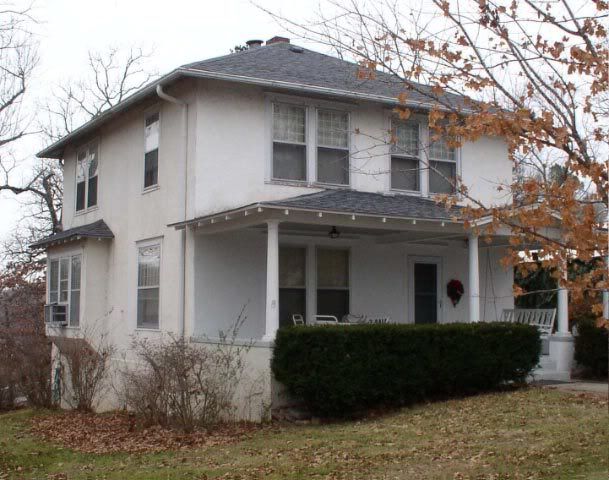
Daniel, our excellent, meticulous painter, has finally completed our exterior paint job. Here's a before: (I think the house has always been white or off-white)
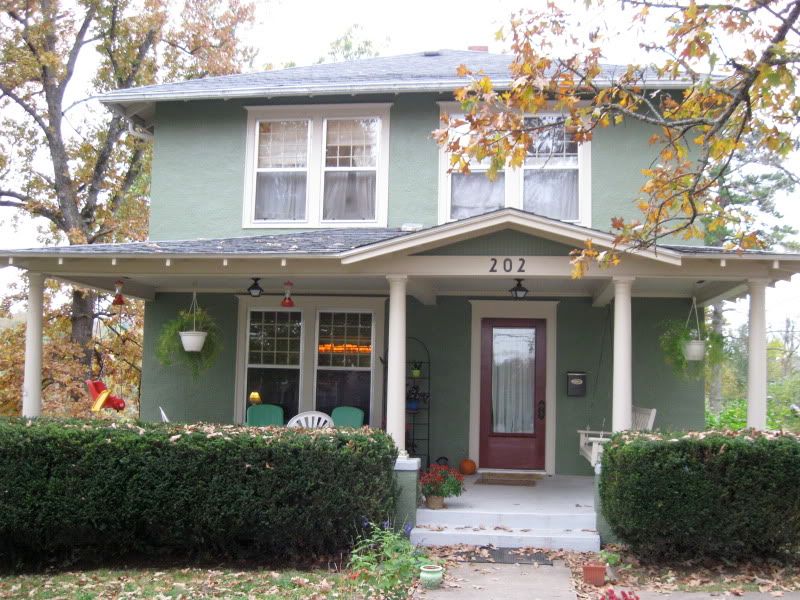
And here's an after:
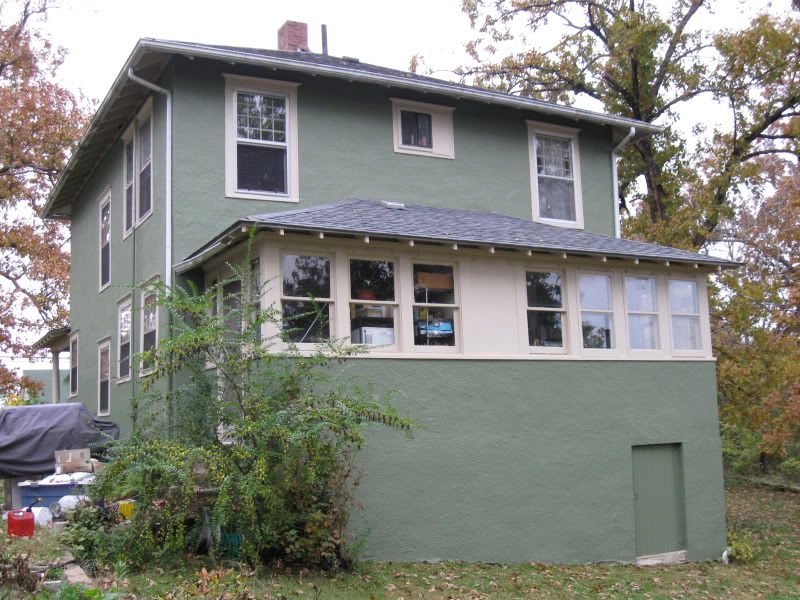
He found surprisingly little rot considering how bare some of the window woodwork was. We chose colors from Benjamin Moore, Daniel's paint of choice.
(Woodwork: Shaker Beige. Walls: Great Barrington Green. Door: Country Redwood. I love BM's Cottage Red, but with the door in the shade of the porch so much of the day, we went a few shades lighter to get the same effect from the street. Very happy with the results!)
Our dog, naturally, has cheerfully begun to wear the paint off the front door with her nails, right through the new red AND old white paint, right down to the wood. I want to kill her.
Still left to do: stripping off the ravenous garage-eating ivy enough to repaint the eaves in the Shaker Beige. (No immediate plans for this, unfortunately; we have more pressing matters to attend to inside.)
And here's an after:
He found surprisingly little rot considering how bare some of the window woodwork was. We chose colors from Benjamin Moore, Daniel's paint of choice.
(Woodwork: Shaker Beige. Walls: Great Barrington Green. Door: Country Redwood. I love BM's Cottage Red, but with the door in the shade of the porch so much of the day, we went a few shades lighter to get the same effect from the street. Very happy with the results!)
Our dog, naturally, has cheerfully begun to wear the paint off the front door with her nails, right through the new red AND old white paint, right down to the wood. I want to kill her.
Still left to do: stripping off the ravenous garage-eating ivy enough to repaint the eaves in the Shaker Beige. (No immediate plans for this, unfortunately; we have more pressing matters to attend to inside.)
Subscribe to:
Posts (Atom)